
Teachers at FJH use standards-based grading practices to measure what students know and can do. This is a quick rundown of what that means for you and your student.
What Is Standards-Based Grading?
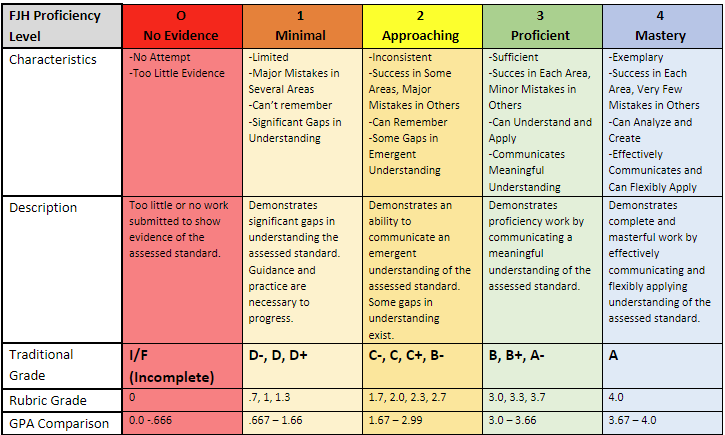
The basic idea behind standards-based grading is that each assessment a student completes (an assignment, quiz, essay, etc.) is tied to an educational standard for the class. Student work is graded on a 4-point rubric scale.
Understanding the Scale
The easiest way for parents and students to understand the rubric is to compare it to traditional letter grades:
4 = A
3 = B
2 = C
1 = D
0 = F
The rubric also includes midpoints that correspond to grades such as B+ or C-. An image above defines each rubric level.
Note: Teachers may also give a score of 0. (zero with a decimal), which equals 59% on an assignment. This score is generally used when a student completed some of the work, but there isn’t enough evidence to show real learning on the standard.
Benefits for Educators
Standards-based grading is extremely useful for teachers. Rubric scores make it easy to see quickly how well each student understands the material. Teachers can then offer extension activities to students who already understand the content and remediation to those who need more support.
Grades also reflect what students actually know and can do relative to the course’s learning objectives. They are no longer inflated by participation-type activities, random extra credit, or assignments unrelated to the learning objectives.
Benefits for Students
This approach benefits students as well. Gone are the days when teachers covered content, tested it, and moved on. Under this system, if a student does not demonstrate proficiency on a standard, the content or skill is retaught, and the student has the opportunity to be re-graded on that standard.